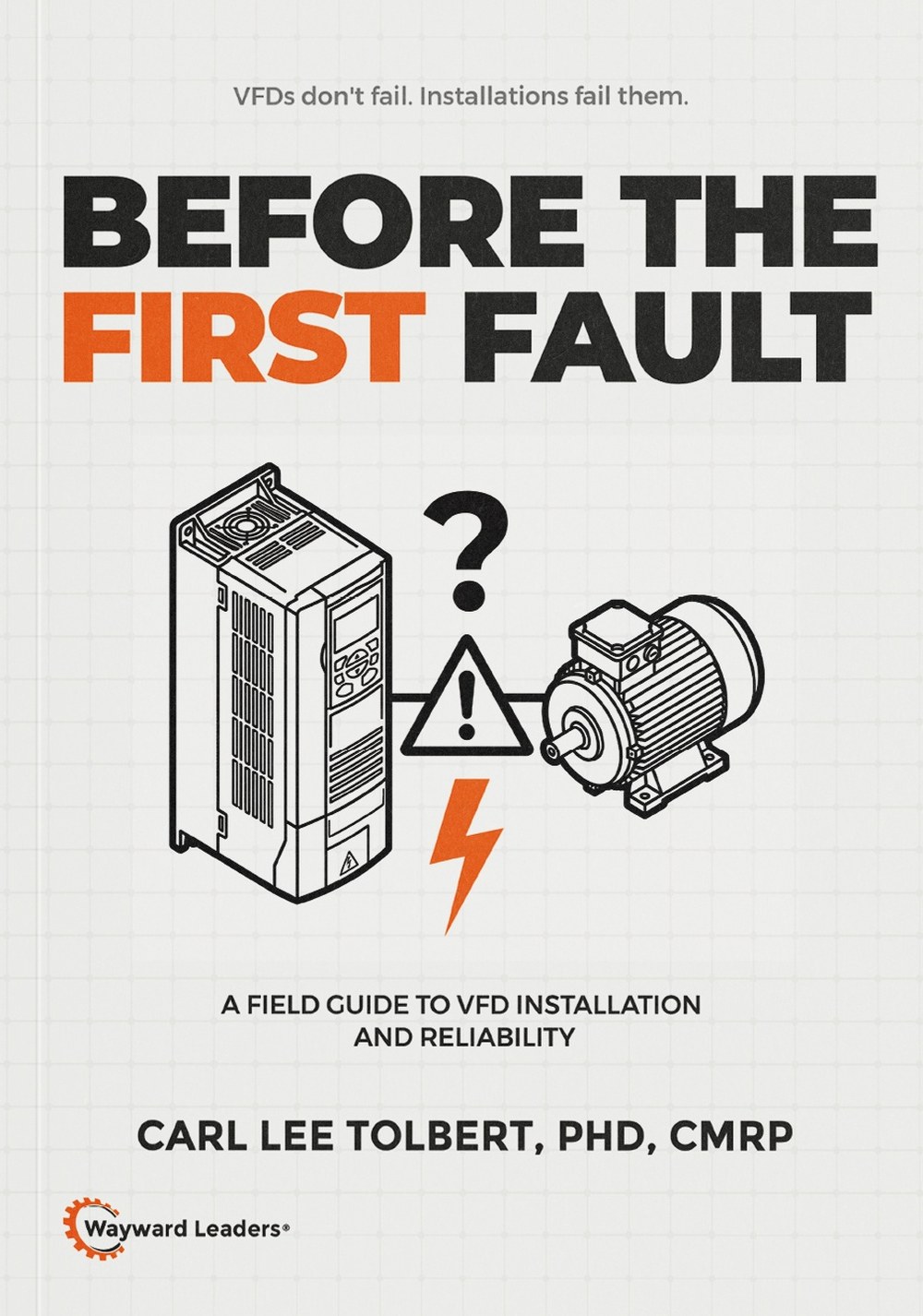
The hardware is excellent. Top-tier manufacturers report annual failure rates below 0.5%, and published mean time between failure figures routinely exceed 200,000 hours. The field results are not what those numbers promise.
More than 80% of early VFD failures trace to preventable installation and commissioning decisions rather than hardware defects. Overheating accounts for roughly 50% to 60% of reported failures. Overcurrent and overload account for about 30%. Bearing damage from electrically induced discharge affects an estimated half of variable frequency drive motor systems where no mitigation was installed.
None of that is a drive problem. It is a decision problem, and every one of those decisions is made before the drive ever runs.
That is the whole argument of the book, and it is the reason it is organized around the sequence of a project rather than around the parts of a drive.
Who it is for
Field technicians and electricians who install, commission, and troubleshoot drives and want the reasoning behind the procedure rather than a parameter list.
Plant engineers and maintenance engineers who specify the equipment and live with the consequences, and who need the sizing and derating math that nameplate matching leaves out.
Reliability and maintenance managers deciding whether the recurring work order on Pump 7 is a drive problem or an installation problem, and what it would cost to stop it.
Integrators, distributors, and specialists who write drives into a bid and then own the startup.
What it is not
It is not a programming manual. It does not replace the firmware manual for your unit, and it says so in every chapter where parameter numbers appear. It is the book that should be on site before the drive is.
Wayward Leaders® is a veteran-owned VFD training practice. We teach maintenance teams and plant electricians to install, commission, and troubleshoot variable frequency drives correctly, in person, at the plant that owns the equipment, anywhere in the United States.
Every class ends with a scored competency assessment. The plant gets a way to prove what each technician can do, not a roster of who sat in the room.
The instruction is field-trained. It is drawn from nearly 8,000 VFD, power, and motor documents and from more than 750 commissioned drives captured through personal field experience and data collection. Carl Lee Tolbert, PhD, CMRP, and ATD Master Trainer® candidate, leads it. He has delivered more than 5,000 hours of VFD instruction across 30 years and trained 8,000 industrial professionals, from International Paper to the U.S. Navy.
The premise is simple: VFDs do not fail. Installations fail them. The curriculum is built backward from that.
Installation, commissioning, troubleshooting, and fault diagnosis guides are published openly at waywardleaders.com.
Contents
Five parts, in the order a drive project actually happens.
Part I · Before the Drive Arrives
Everything decided before anything is mounted: what the drive is, what the load demands, what the conditions take away, and what gets written into the specification.
Why This Book Exists
Understanding What You Are Installing
Sizing the Drive Correctly
Selecting the Motor
Specifying Cables, Accessories, and Input Power Protection
Understanding the Application
Part II · Physical Installation
Where the drive lives and how it is wired. Environment and enclosure, panel layout, power and control wiring, cable and shield termination, grounding and bonding.
Location, Environment, and Enclosure Design
Panel Layout and Mechanical Installation
Power Wiring and Circuit Protection
VFD Cable Installation and Shield Termination
Grounding and Bonding
Control, Communication, and Analog Wiring
Part III · Commissioning
The sequence from a panel that has never been energized to a machine running under load, with the safety systems proven rather than assumed.
Pre-Energization Checks
First Power-Up and Parameter Configuration
First Rotation and Load Testing
Safety System Verification
Part IV · The First Weeks of Operation
The weeks that decide whether the installation holds. The baseline that everything later is measured against, the faults that show up first and what they are actually reporting, and the documentation that gets handed over.
Establishing the Operational Baseline
Common First-Week Faults and What They Mean
Tuning and Optimization
Handoff and Documentation
Part V · Looking Forward
What the drive can do beyond the basic configuration, what makes it last, and what it has been telling you the whole time.
Advanced Configurations
Setting Up for Long-Term Reliability
The Drive Is Listening
Appendices
ORCA-Size Technical Reference
Pre-Energization Installation and Commissioning Checklist
Parameter Cross-Reference
Short Circuit Current Calculations
Braking Resistor Sizing and the ORCA-Size Worksheet
Three things recur in every chapter
Field examples. Named, specific, and drawn from installations that actually failed. The Denver conveyor sized to nameplate. The Phoenix booster pumps at 71 degrees inside a NEMA 3R enclosure in July. The cooling tower fan that kept spinning when the interlock door opened.
Worked calculations. The derating math, the imbalance math, the thermal math, carried through with real numbers rather than stated as principles.
Verification checklists and diagnostic flowcharts. Built to be used at the panel rather than read at a desk.
What it is built from
The guidance is a synthesis of ABB, Rockwell Automation, Eaton, and Siemens published documentation, checked against a reference library of nearly 8,000 VFD, power, and motor documents and against more than 750 commissioned drives.
Where manufacturers disagree, the book says so and explains the disagreement rather than picking a house brand.
The guides on this site are chapters of it
The VFD guides published openly at waywardleaders.com are drawn from the book, one part at a time. Read them first if you want to know whether the full text is worth your time.
All too often, the VFD gets a 'bad rap' for being too complicated, or not performing as it should, or failing when it shouldn't. Experience indicates that likely two-thirds of VFD installation issues are related to improper shielding, input or motor cable grounding, control signal cabling laying too close to power cables, and conducted or radiated noise characteristics, all of which indicate improper installation techniques.
We have spent a lot of years staring at drives that quit working long before they should have. We stopped saying drives die a long time ago. Drives don't die. Drives get murdered. The only question left is what kind of homicide we're looking at.
This book by Carl Lee Tolbert aims at cutting through the clutter, theory and misconceptions, providing real-world examples of applications that work as designed, and control the process efficiently and effectively.
Expanded digital edition, direct from the author
$29.99 · Gumroad
Reached #1 in Amazon's Industrial Production and Management category.
Training
A clean install is a skill and it is teachable. Wayward Leaders teaches maintenance teams and plant electricians to install, commission, and troubleshoot variable frequency drives on site, at the plant that owns the equipment.