
Free field guide + video
What Is a VFD?
The basics from my VFD class, in a 7 minute video and a free 14 page guide: what a drive does, what is inside it, how it makes speed, and how to tell when the motor in front of you needs one.
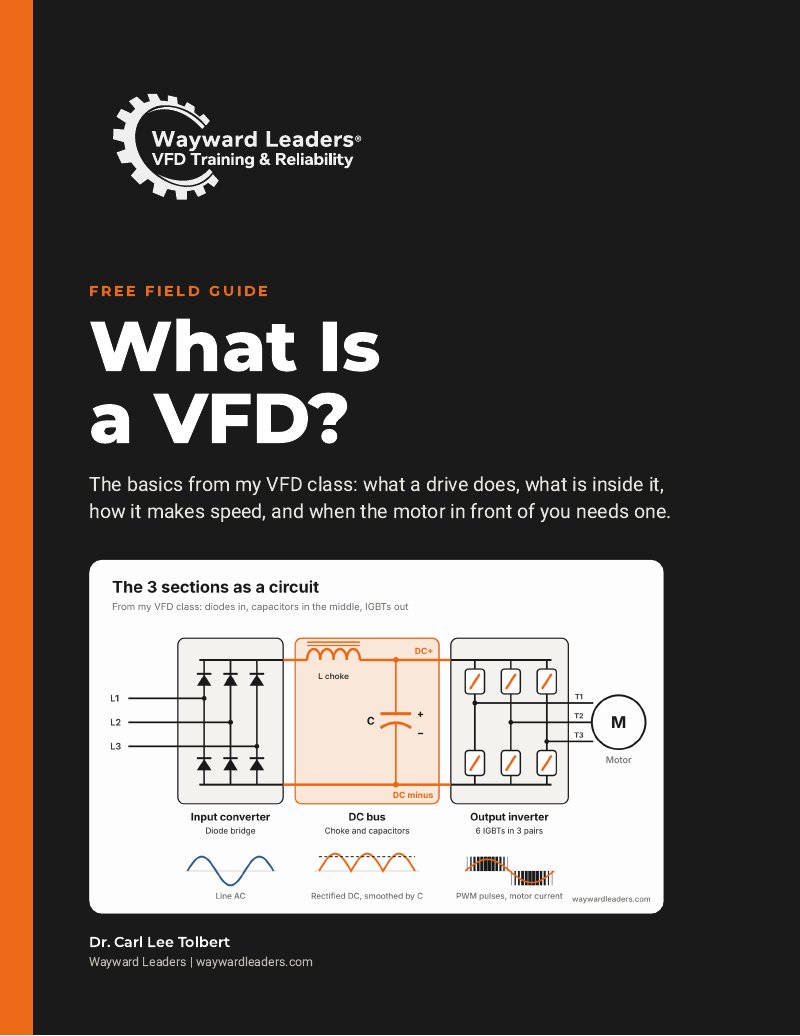
A variable frequency drive is the most common piece of power electronics in a plant, and most of the people who work on one learned it a parameter at a time. This guide starts where my class starts: what the drive is for, what is inside every one of them regardless of the brand on the door, and how to check each part with a meter.
Free, no email, no signup. Print it and carry it, or keep it on your phone.
Download the free guide (PDF, 14 pages) Take the free class
Watch: What Is a VFD? (7 minutes)
Prefer to read? Everything in the video is in the free guide, plus the meter checks.
What is in the guide
- Get your motor running: 3 common ways
- All the names, and a definition
- What every VFD does
- Volts per hertz
- The 3 sections inside every drive
- How the drive makes speed: slice, squeeze, squirt
- Only 4 kinds of load
- Control arrangements
- Parts of a VFD, the panel and the system
- Checking the 3 sections with a meter
- What a drive costs the motor and the building
The definition
Very simply stated, the variable frequency drive controls the motor so that it may be run at very low speeds, very high speeds or anywhere in between.
Larry Stanley
You will hear it called an AFD, an ASD, a VSD, a frequency converter or an inverter. In the United States, the industry settled on variable frequency drive, or VFD.
3 common ways to start a motor
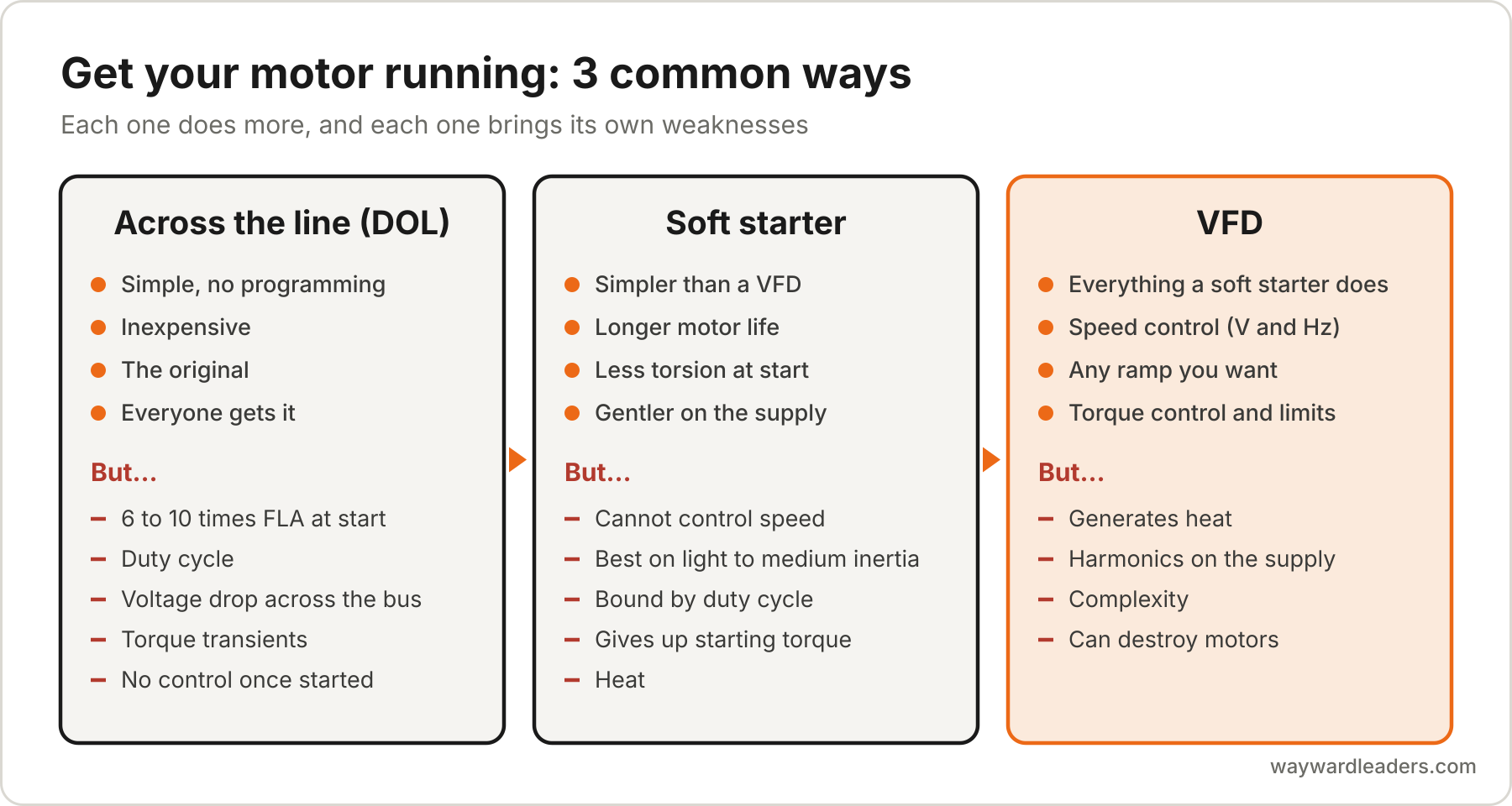
Across the line is simple and cheap and slams the load at start. A soft starter softens the start, works best on light to medium inertia, and cannot control speed. A VFD does what a soft starter does and controls speed the whole time the motor runs. The full comparison is in soft starter vs VFD.
The 3 sections inside every drive
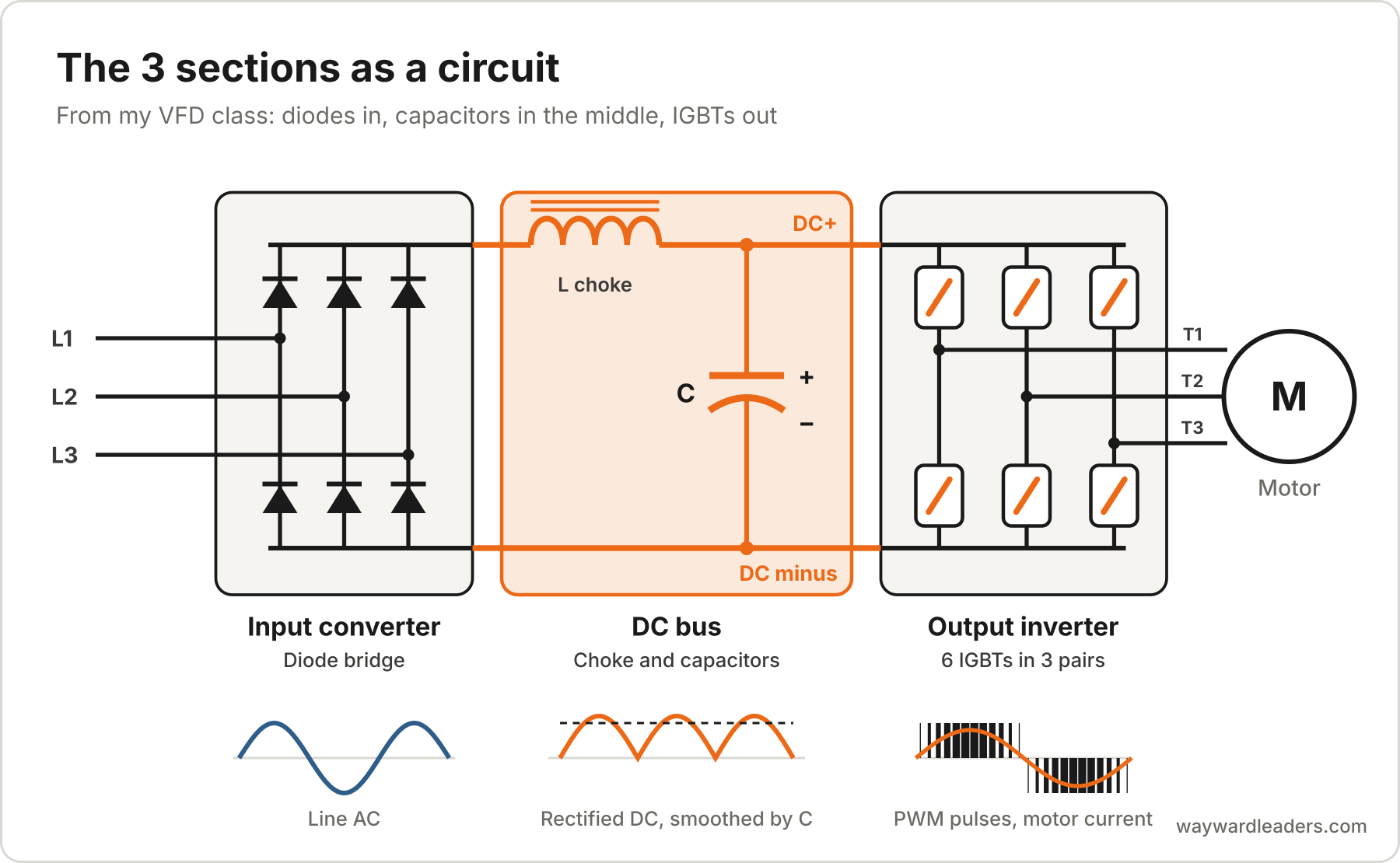
Open any standard 6 pulse drive and you will find the same 3 sections, from AC to DC and back to AC. On a 480 V supply the DC bus sits around 650 VDC, about 1.35 times the line. That bus stays charged after the power is off, so prove it dead with a meter before you touch anything inside.
How the drive makes speed
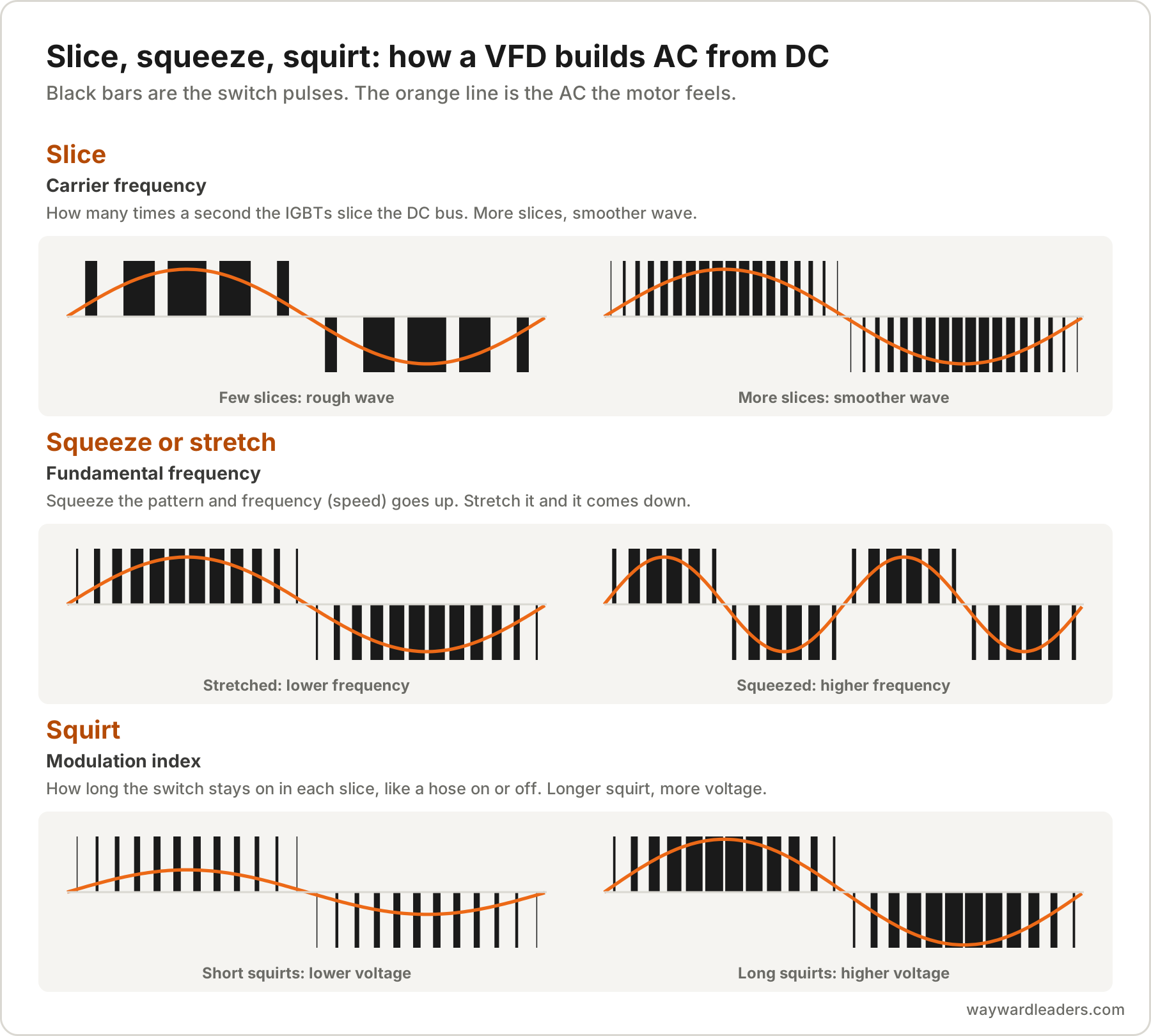
I teach PWM as slice, squeeze and squirt. Slice is the carrier frequency, squeeze sets the output frequency and the speed, and squirt sets the output voltage. The drive moves voltage and frequency together, about 7.67 volts per hertz on a 460 V motor, so the motor's flux and torque hold steady.
Keep going
- The free class. What Is a VFD? at The Tolbert School, with short quizzes and a certificate.
- The long read. The field note What Is a VFD, and How Does a VFD Work? covers every section in more depth, with the meter checks step by step.
- Installing one? The free First Power course at The Tolbert School teaches the checks before the first power up, and the VFD Installation Guide walks through the install in order.
The parts of the drive that cost a motor its life are covered in their own notes: inverter duty motors, VFD cable, dV/dt filters and load reactors and shaft grounding rings.
The guide is the vocabulary. The training is where it sticks.
A tech who has walked the 3 sections with a meter on live hardware reads a fault code differently than one who has only read about them.
Wayward Leaders® is a veteran-owned VFD training practice. We teach maintenance teams and plant electricians to install, commission, and troubleshoot variable frequency drives correctly.
Every class ends with a scored competency assessment. The plant gets a way to prove what each technician can do, not a roster of who sat in the room.
The instruction is field-trained. It is drawn from nearly 8,000 VFD, power, and motor documents and from more than 750 commissioned drives captured through personal field experience and data collection. Carl Lee Tolbert, PhD, CMRP, and ATD Master Trainer™, leads it. He has delivered more than 5,000 hours of VFD instruction across 30 years and trained 8,000 industrial professionals, from International Paper to the U.S. Navy.
The premise is simple: VFDs do not fail. Installations fail them. The curriculum is built backward from that.
Installation, commissioning, troubleshooting, and fault diagnosis guides are published openly at waywardleaders.com.